TL;DR
TON’s native token was officially renamed from Toncoin (TON) to Gram (GRAM) on June 15, 2026. The community vote passed with 81.22% support. The rename required no swap or migration. The chain remains The Open Network. “TON/GRAM” refers to the same asset here, called GRAM throughout. Official rebrand announcement
This is TON’s most complete narrative so far, but fundamentals have yet to catch up. Telegram is bringing native wallets and zero-fee transfers to its one billion users and has applied for the .gram top-level domain. Daily on-chain transactions have reached 4.29 million. Yet chain-wide TVL is only $246 million, 82% in liquid staking, and daily chain fees average just about $2,200–2,600. A $3.07 billion market cap implies 12.5× market cap/TVL, against 4.1× for SOL and 2.7× for ETH, and roughly 1,770× trailing-12-month fees. The valuation depends largely on distribution turning into usage and revenue. Current fees offer limited support.
The largest single event is on the calendar. About 1.13 billion GRAM unlock on February 26, 2027, representing 21.3% of supply, roughly $1.2 billion, and about 39% of current circulating supply.
1. Identity and market position: the name returned, the price did not
The rebrand restores the original 2018 name, while forcing the market to relearn the ticker. Telegram raised about $1.7 billion under the Gram name in 2018. The SEC halted the project in 2020, leading to over $1.2 billion in refunds and an $18.5 million penalty. After the community took over, the token became Toncoin to distance it from that regulatory history. On May 4, 2026, Telegram announced that it would replace the TON Foundation as the network’s leading participant and become its largest validator. GRAM rose 33.8% that day, reached around $2.50 within a week, and approximately $2.70 at its May high. The rebrand took effect on June 15, and the native Gram wallet inside Telegram launched on August 31. crypto.news
Several assets use “GRAM” or similar tickers. The asset discussed here is the former Toncoin, valued in the billions of dollars. Others include a separate PoW Gram worth only a few million dollars with a price measured in cents, GRM, and GRAMPUS. Check that it is The Open Network’s native coin and labeled “prev. Toncoin.” A billion-dollar market cap is only a secondary check.
Snapshot as of November 18, 2026.
| Metric | Value |
|---|---|
| Price | $1.0698 (24h +3.6%, 7d −7.8%, 30d −20.9%, 365d −40.3%) |
| Market cap / rank | $3.07 billion / #29 (#25 under CMC’s methodology) |
| FDV | $5.65 billion, or 1.84× market cap |
| Circulating / total supply | 2.870 billion / 5.286 billion, with no maximum cap |
| 24h volume | $65.2 million ($104 million under another methodology) |
| Drawdown | −87% from the $8.25 ATH on June 14, 2024; −60% from the May high |
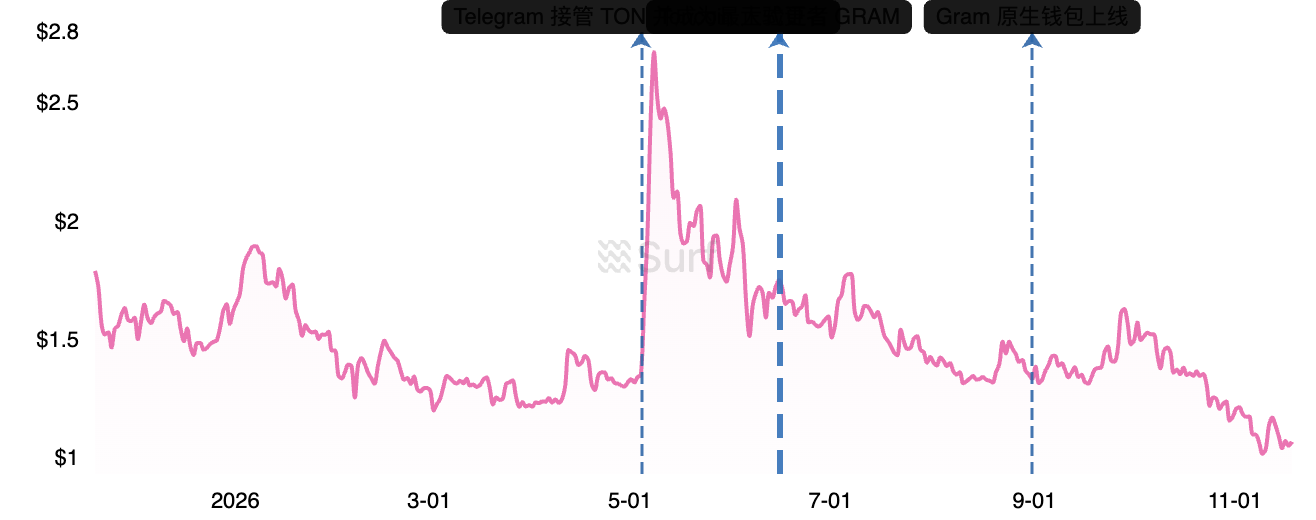
Author-supplied chart with its original Chinese event labels.
The takeover, speed and fee improvements, and rebrand clustered in May–August. Price responded in May, then stepped down for three consecutive months. My interpretation is that the market priced Telegram’s return as a one-time event. Execution data must justify what follows.
2. Token economics: issuance has changed and a concentrated unlock is approaching
Under the community-network distribution framework used in the source, TON follows a mining-based model with no private allocation or team share and new issuance funding security. This describes distribution after the community took over, a different phase from Telegram’s 2018 fundraising. CoinGlass divides the 5.286 billion supply into pre-mined tokens, 44.2%; Believers Fund, 25.6%; inactive miners, 21.0%; vested wallets, 6.2%; and inflation, 3.0%. 58.5%, or 3.09 billion tokens, are unlocked, with full unlocking scheduled for November 2028. CoinGlass
| Unlock date | Tokens | Share of total | USD value | Main categories |
|---|---|---|---|---|
| 2026-11-26 | 45.58 million | 0.86% | $49.09 million | Believers Fund / vested wallets |
| 2026-12-26 | 45.37 million | 0.86% | $48.87 million | Same |
| 2027-01-26 | 46.39 million | 0.88% | $49.96 million | Same |
| 2027-02-26 | 1.13 billion | 21.34% | $1.21 billion | Inactive miners + Believers Fund |
| 2027-03-26 | 44.14 million | 0.84% | $47.54 million | Believers Fund / vested wallets |
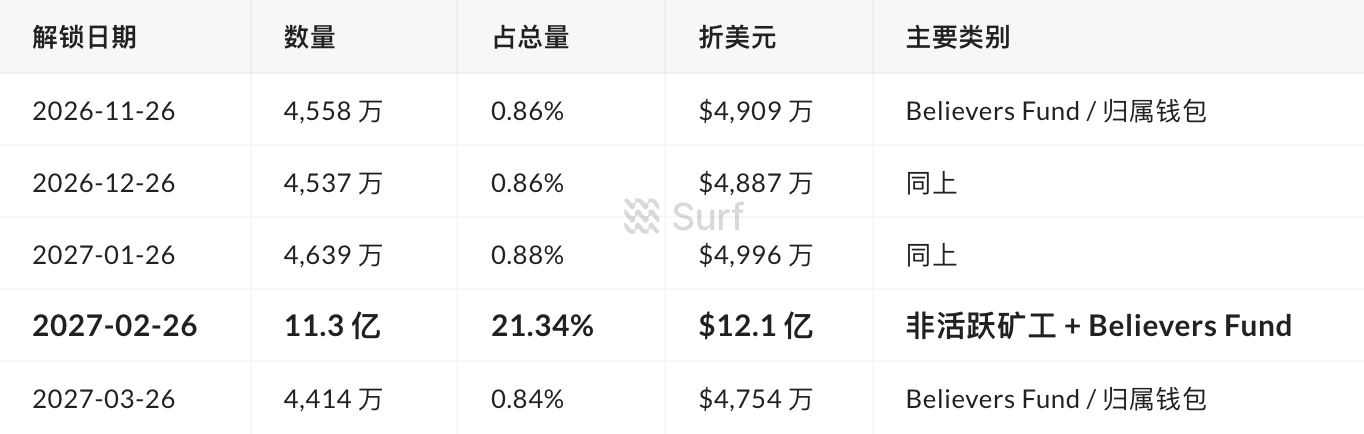
Original table supplied by the author. USD conversions retain the report’s snapshot.
This year’s performance upgrade increased issuance, a change I believe remains underappreciated. Catchain 2.0 brought blocks to around 400 milliseconds, finality to around one second, and block frequency to about 5–6 times its previous level. Validator rewards rose alongside it. Annual inflation increased from around 0.6% to 2.7% under TonStat’s rolling measure, or about 4% when monthly issuance is annualized. TonStat shows around 573,000 GRAM minted daily against about 1,206 burned. At that daily pace, annual issuance would be about 210 million tokens, roughly 4% of total supply or 7% of circulating supply. Keep the rolling inflation measure separate from an extrapolation of one day. The 21Shares methodology cited in the source puts first-half net dilution at 9.6%, against 5.5% for XRP and 8.8% for XLM. TonStat · Catchain 2.0 documentation
Fee burning is the offset mechanism considered here. TON burns 50% of transaction fees. With daily fees of about 2,412 GRAM, or $2,580, burning offsets only about 0.2% of new issuance. Burning remains far below issuance, so GRAM supply continues to grow.
Staking adds another constraint. 660.8 million GRAM are staked, about 23% of circulating supply, across 361 validators in 30 countries. 178 million tokens are held through liquid staking protocols. The quoted yields require matching periods. TON Strategy’s Q3 gross quarterly staking yield was about 4.09%, while its announcement reports an annualized gross yield of about 16%. The source separately lists LST yields of 4.5–6% and 3.5–4.5% for the five-year Believers Fund lock. Their observation periods, fees, and accrual rules still need confirmation. Subtracting roughly 4% annual inflation from a 4.09% quarterly yield cannot establish a near-zero real yield. Assess yield, supply dilution, and dollar-price risk separately. TON Strategy Q3 announcement · Form 10-Q
3. Ecosystem: growing payments, shrinking DeFi depth
TON’s current usage leans toward transfers and payments, with limited depth in capital-allocation applications. Chain-wide TVL of $246.1 million is 79% below the $1.153 billion peak on July 16, 2024. It has nevertheless risen during 2026, from $198 million at the start of the year to about $246 million, up 24%. Liquid staking dominates that TVL.
| Protocol | Category | TVL | Share |
|---|---|---|---|
| Tonstakers | Liquid staking | $160.9 million | 65% |
| Stakee | Liquid staking | $22.92 million | 9% |
| STON.fi | DEX | $20.59 million | 8% |
| Hipo | Liquid staking | $9.24 million | 4% |
| EVAA Protocol | Lending | $6.95 million | 3% |
| KTON / bemo | Liquid staking | $8.46 million | 3% |
| Storm Trade | Derivatives | $3.40 million | 1% |
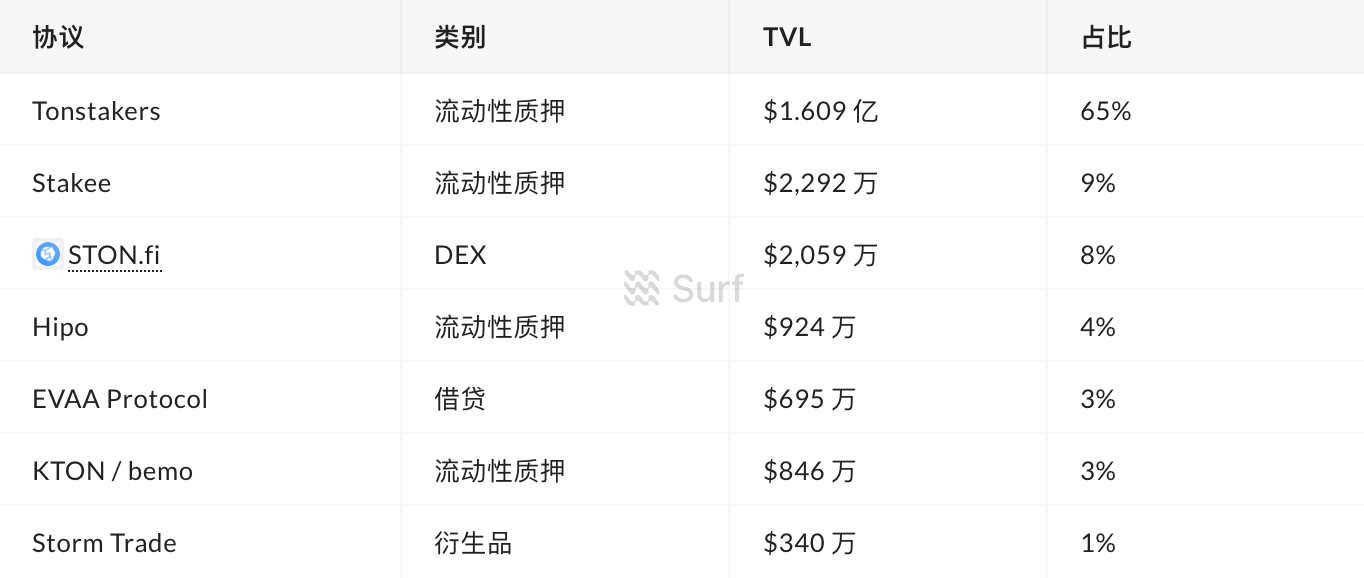
Original table supplied by the author. The text table above provides the same data in English.
The LST entries total about $201 million, or 82% of TVL. DeFi TVL excluding LSTs is about $45 million, consistent with the $45.7 million DeFiLlama figure cited by PANews. DEX depth is also thin. STON.fi traded $3.34 million in 24 hours and $84.16 million in 30 days. With DeDust at $720,000 and TONCO at $190,000, chain-wide DEX daily volume is around $4–5 million, a small fraction of a single day on Uniswap.
Stablecoins provide a contrast. TON has $578.5 million of circulating stablecoins, mainly USDT, or 2.35× TVL. Tether’s July expansion of native USDT and STON.fi’s Omniston connections to TRON and EVM stablecoin routes reinforce the transfer-and-payments use case.
Applications are numerous. The ton.app directory lists 787 games, 219 tools, 77 wallets, 40 DEXs, 36 launchpads, 29 staking apps, and six RWA apps. Activity is concentrated in games and social products, with shallow financial depth. Telegram’s own uses still generate substantial activity. Gift markets traded $44.8 million in 30 days, equivalent to 40.8 million TON across 1.91 million trades. Polymarket connected through Predict in June, and Telegram applied to ICANN for the .gram top-level domain.
Network metrics are a bright spot and a strong part of the bullish case. TonStat reports 4.29 million daily transactions, 207 million total accounts, 65.01 million activated wallets, 185,000 daily active addresses, 5.08 million monthly active addresses, and 67,000 daily activations. Accounts and addresses do not directly count unique people. Fees of about $0.00056 per transaction fit a service intended for a billion people.
Infrastructure fragility surfaced in April. Lite Servers and full nodes persistently fell out of sync, returning Error 651 and preventing wallets and dApps from reading state at scale. The source describes this as the second incident of its kind since April 2024. Validation continued, but for consumer products I consider an unreadable chain more damaging than a short outage.
4. Community: 6.157 million subscribers and 1.5% activity
I see TON’s distribution as among the strongest in crypto, but attention has declined sharply over roughly six months. The official X account, @ton_blockchain, has 2.353 million followers, and Telegram’s @toncoin channel has 6.157 million subscribers. Few L1s match that scale. Daily X views peaked at 4.009 million on May 7, after the takeover announcement. By November 17, they were 54,000, down 98.6%. The 30-day average was 71,000, slightly above 56,000 over the preceding 30 days.
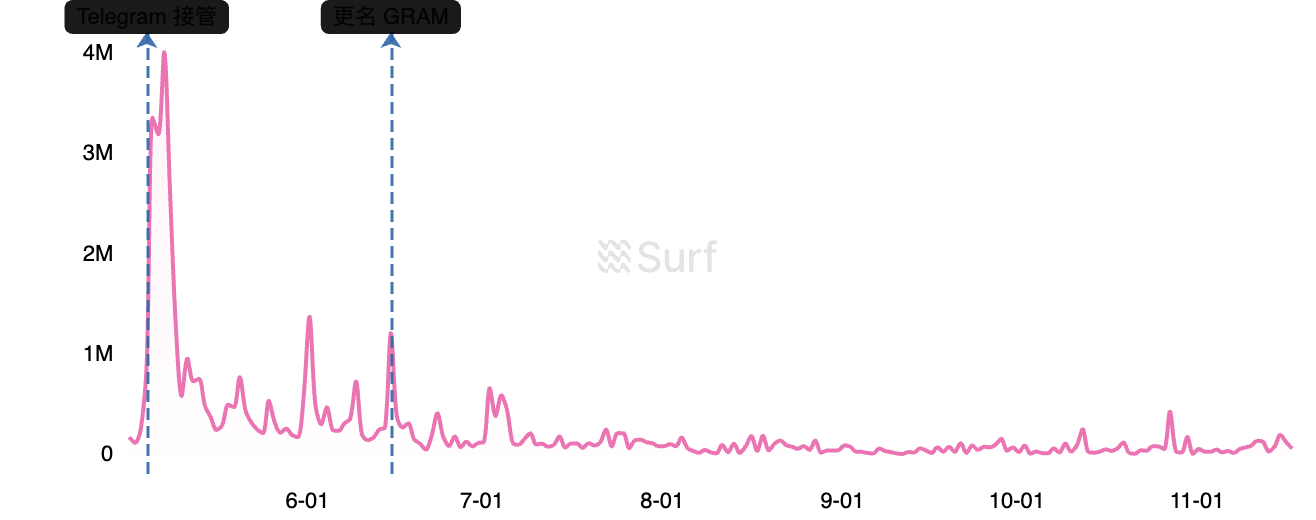
Author-supplied chart with its original Chinese event labels.
Wallet activation quality deserves scrutiny. By November 12, self-custodial Gram wallets inside Telegram reached 3.53 million, including roughly 650,000–710,000 additions in 48 hours. Yet daily active addresses numbered only about 53,000, or 1.5%. Just 188,000 addresses held a balance, totaling 1.683 million GRAM, about $2.05 million, less than $11 per funded address on average. Receiving 0.1 GRAM automatically activates a wallet without registration or a seed phrase. Automatic activation expands account creation. Activity and balance data must show how much actual usage follows.
Governance and influence are also concentrating. The rename passed with 81.22% support under the voting procedure. The source is concerned that Telegram now combines ecosystem leadership, the largest validator, and the wallet issuer. “Replacing” the foundation here describes a change in leadership. It does not establish that the foundation’s legal entity or governance framework has been replaced by a company. Durov’s message coincided with a 33.8% daily token gain. He called GRAM “severely undervalued,” argued it should rank among the top three assets by market cap, and changed his X bio to “Founder of TON blockchain (2019).” One person’s influence is both a catalyst and a point of dependency.
The holder mix illustrates the cost of conviction. The Believers Fund locked over one billion tokens for five years, comprising a two-year cliff and 36 months of linear release. Its quoted yield is below liquid staking. The source reads this as holders accepting a liquidity cost for a long-term belief. A precise yield comparison still requires matching periods.
5. Valuation and risk: distribution and cash generation
GRAM trades at higher multiples than the peer snapshots below. My explanation for the premium is the option on converting Telegram’s distribution.
| Metric | GRAM | SOL | ETH |
|---|---|---|---|
| Market cap | $3.07 billion | $44.28 billion | $221.53 billion |
| Chain TVL | $246 million | $10.75 billion | $83.23 billion |
| Market cap / TVL | 12.5× | 4.1× | 2.7× |
| Market cap / DeFi TVL excluding LSTs | About 68× | — | — |
Fee multiples are higher still. $1.73 million of chain fees over the last 12 months implies P/F of about 1,770×. Annualizing the last 30 days gives nearly 3,800×. Burning 50% corresponds to about $870,000 a year and a market-cap-to-burn ratio near 3,500×. That ratio measures burn scale. It is neither P/S nor a cash dividend to holders. TON Strategy (Nasdaq: TONX), by comparison, held 235.1 million GRAM as of September 30, 2026, about 8.2% of circulating supply, and reported Q3 staking revenue of $13.1 million and a net loss of $24 million. My view is that a DAT structure can amplify asset-price risk in a falling market and may offer little price support.
Three scenarios follow. These are analytical exercises, not forecasts.
- Bear case, assigned the higher probability. Wallet adoption stalls at activation, non-LST TVL remains below $50 million, and the February 2027 unlock of 1.13 billion tokens combines with 4% inflation. Price returns to $0.60–0.80. Holding current circulating supply at 2.870 billion and TVL at $246 million implies about 7.0–9.3× market cap/TVL, above the SOL snapshot. Recalculate after the unlock.
- Base case. Payments gain ground steadily, stablecoins grow from $580 million to $1 billion, TVL recovers to $400–500 million, and price reaches $1.20–1.60.
- Bull case. The remaining three MTONGA steps, including payment and identity products, arrive alongside .gram domain adoption and merchant payments inside Telegram. Non-LST TVL exceeds $200 million and price returns to $2.50–3.00, around the May high.
Risks, in descending order of importance, are the February 2027 supply shock at 21.3% of total supply; inflation rising from 0.6% to 4%, beyond what burning offsets; concentration of leadership, the largest validator, and wallet roles in Telegram, alongside its domain application and the still-to-be-verified governance implications of that leadership shift; dependence on Telegram for nearly all user entry points; infrastructure reliability after April’s sync failure; the regulatory history and US market access; and confusion with similarly named tokens that can damage liquidity and trust.
Four leading indicators may turn before price. Watch the Gram wallet’s daily-active-to-total ratio, currently 1.5%, for progress toward 5%; DeFi TVL excluding LSTs, currently around $45 million; daily chain fees, currently about $2,200–2,600, with fees above $10,000 a day indicating a step up in usage; and stablecoin supply, currently $578.5 million.
Conclusion
GRAM’s valuation rests on the option that Telegram turns one billion people into 100 million payment users. Current chain fees remain weak. The bullish case includes 4.29 million daily transactions, $580 million in stablecoins, a channel with roughly 6.16 million subscribers, about $0.0005 per transaction, and a team recently brought back under its founder’s leadership. The bearish case includes 82% of TVL in staking-related assets, 1.5% wallet activity, 1,770× P/F, and February 2027’s unlock of about 21% of total supply.
My assessment remains strong distribution, shallow capital depth, and a high valuation. Renaming completes the story but leaves the revenue structure intact. Until fees and non-LST DeFi improve by an order of magnitude, I would primarily view rebounds through the narrative window and wait for usage and revenue to validate the valuation. In this framework, the period before February 2027 favors the narrative, and the period after it puts valuation under pressure. This is a supply-event scenario, not a fixed timetable for price.
Data note. Market and ecosystem figures retain the source’s November 18, 2026 snapshot and their stated observation windows. Beyond items directly checkable at the linked sources, this review did not reconstruct all price and social histories, wallet records, or external platform series. The four illustrations were supplied separately by the author.